


The map is huge, the largest held by the ERO measuring over 30 feet long and almost 13 feet wide and after talking to archivists and other staff I was in awe of the fact that they able to display it all. The other two copies of this magnificent map are held at the London Metropolitan Archive (for the Corporation of London) and the National Archives at Kew (for The Crown) whilst this one belongs to Essex! The Arbitrator was Sir Arthur Hobhouse QC and his brief was to determine which illegally included land should remain enclosed and which were to be open again. The Map is a result of that very important work and was published in July 1882.

(Photo courtesy of Essex Record Office Twitter Feed)
The importance of this map to the area in general and Loughton, in particular, cannot be underestimated. The map painted on paper and linen backed was drawn up only four years after the Epping Forest Act of 1878 which ended the right of local people to lop wood in an enormous area covering about 6,000 acres. This map followed on from the long drawn out arbitration process which would eventually secure Epping Forest's future under the conservatorship of the Corporation of London. This Act meant that it was no longer a Royal Forest and stopped the Crown's right to venison as well as stipulating that the Conservators.....
"shall at all times keep Epping Forest unenclosed and unbuilt on as an open space for the recreation and enjoyment of the people"
A few months previously on Saturday, May 6th 1882 Queen Victoria arrived at Chingford Station by Royal Train and took a carriage drive to High Beech to officially hand over Epping Forest to the people. The evening before it had rained but on this day they were greeted with sunshine and as one newspaper states "The wind was a gentle zephyr". Carts and carriages lined the route through the forest but were requested to leave enough room for people who stood eight to ten deep along the roadside. The station at Chingford only a few years old at this time was adorned with flowers, flags, and garlands as well as sporting a red carpet on the platform. Throughout the day up to ten Great Eastern Railway Company trains an hour left Liverpool Street to take sightseers to either Loughton or Chingford Stations where they might get the best vantage point but helpful notices in the press also suggested they use Ponders End Station and take a walk through the beautiful forest.
At Chingford Victoria's arrival was greeted by over 1,100 invited guests seated in grandstands on the station yard as well as a Forest Sub-Reception Committee already awaiting in carriages. As always timing was the key to these Royal visits and the Royal Party arrived punctually at 4.30pm. The Queen was joined in her carriage by HRH Princess Louise, HRH Princess Beatrice as well as the Duchess of Connaught, wife of Prince Arthur, Duke of Connaught, the third son of Victoria and first Ranger of the forest. The Queen was dressed in black as was customary but sported a white ostrich feather in her bonnet and smiled in response to the crowds' cheers.
A few months previously on Saturday, May 6th 1882 Queen Victoria arrived at Chingford Station by Royal Train and took a carriage drive to High Beech to officially hand over Epping Forest to the people. The evening before it had rained but on this day they were greeted with sunshine and as one newspaper states "The wind was a gentle zephyr". Carts and carriages lined the route through the forest but were requested to leave enough room for people who stood eight to ten deep along the roadside. The station at Chingford only a few years old at this time was adorned with flowers, flags, and garlands as well as sporting a red carpet on the platform. Throughout the day up to ten Great Eastern Railway Company trains an hour left Liverpool Street to take sightseers to either Loughton or Chingford Stations where they might get the best vantage point but helpful notices in the press also suggested they use Ponders End Station and take a walk through the beautiful forest.
At Chingford Victoria's arrival was greeted by over 1,100 invited guests seated in grandstands on the station yard as well as a Forest Sub-Reception Committee already awaiting in carriages. As always timing was the key to these Royal visits and the Royal Party arrived punctually at 4.30pm. The Queen was joined in her carriage by HRH Princess Louise, HRH Princess Beatrice as well as the Duchess of Connaught, wife of Prince Arthur, Duke of Connaught, the third son of Victoria and first Ranger of the forest. The Queen was dressed in black as was customary but sported a white ostrich feather in her bonnet and smiled in response to the crowds' cheers.
 |
| Queen Victoria leaves Chingford Station |
The Queen's open carriage was drawn by four horses with postillions and flanked by outriders in scarlet livery. A footman and the Queen's confidante John Brown, in Highland costume, took up places at the rear of the carriage as it made its way through the decorated arch at the front of the station as the 1st Essex Artillery fired a Royal salute and bands played the National Anthem. A long procession of carriages and riders made the four-mile journey to the specially erected amphitheater outside of the Kings Oak public house in High Beech.
 |
The Plan for the 2,000 seat amphitheatre |
The amphitheatre shown in the plan above had seating for 2,000 people and the guests to Epping Forest that day included foreign royals and leaders as well as members of our own Royal Family and political parties. The Corporation of London had many distinguished guests themselves as well as from the Metropolitan Board of Works. I was pleased to see that one of those guests was Enfield born, Sir Joseph Bazalgette their Chief Engineer who had only recently completed his work which would transform the sewage system of London.
After their arrival in High Beech at 4.45pm the Royal Standard was hoisted and the bands of the Coldstream Guards and the Royal Artillery again played the National Anthem. The Queen remained in her carriage throughout proceedings and it was driven up a ramp onto a canopied dais in front of the amphitheatre crowd. A young local girl Victoria Buxton whose father Sir Thomas Fowell Buxton was a Liberal politician and advocate of open spaces, was lifted up to deliver a bouquet to Her Majesty.
 |
| Victoria Buxton presenting the bouquet |
With several speeches and prayers over the Queen herself was able to 'open' the Forest and pronounce it "Free for the enjoyment of the people", At the permission of Her Majesty an oak tree was also planted to commemorate the occasion and she herself was presented with a book of photographs of the Forest by the Lady Mayoress.
The Royal party at this stage returned via the same route to Chingford Station to take a train at 5.30pm and unbelievably arrived back at Windsor Castle for 6.45pm!
A planning document that I found at the London Metropolitan Archive advised that 190 private carriages would be needed to transport guests from Railway Stations to the High Beech site and that none were to leave without having 4 passengers. The document also puts the cost of the event at about £6,330.00 which would be around £650,000.00 in today's money.
 |
| Artwork proof for the Invitation |
As the Queen left the area there were further festivities which culminated in a magnificent firework display at the Royal Forest Hotel as well as many Chinese Lanterns to illuminate the site.
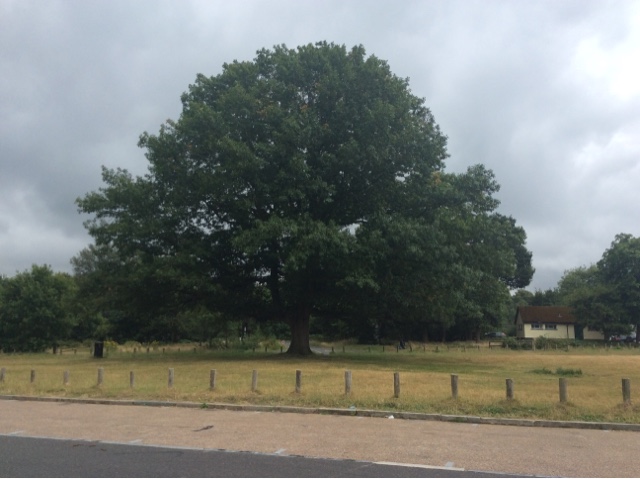
Today the only reminder of that occasion at High Beech is the splendid oak tree planted in her name on that May day in 1882 - although not the same one!


Today the only reminder of that occasion at High Beech is the splendid oak tree planted in her name on that May day in 1882 - although not the same one!


Loughton and the surrounding area have been left with many reminders of the men involved in the 'saving' of the Forest with roads, schools and even a lake named after them such as Buxton Road and Willingale School. The enduring reminder for Loughton though is Lopping Hall on the High Road which was gifted to the parishioners of Loughton in 1884 by the Corporation of London in compensation for the loss of their lopping rights in Epping Forest. The hall cost over £3,000 to built although an amount of £7,000 was given over by the City. The remaining money was put into the accounts of the Lopping Hall Endowment Trust and today as always is a cultural hub for the town.
The Arbitration Map of Epping Forest is a testament to the work involved in keeping the forest in one piece by the Victorians and aside from a few additions remains the same today.
The Arbitration Map of Epping Forest is a testament to the work involved in keeping the forest in one piece by the Victorians and aside from a few additions remains the same today.
REFERENCES;
British Newspaper Archive online... Lloyds Weekly and the London Standard
Photographs of Epping Forest Arbitration Map 1882 courtesy of the Essex Record Office
Plan of High Beech site and Invitation available to view at the London Metropolitan Archive


